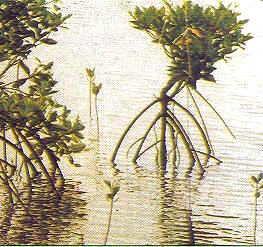
Floral Wealth
of
Andaman & Nicobar Islands
Courtesy : Science Centre, & Department of Environment & Forests
A&N Administration &
Botanical Survey of India, Port Blair
Cyathea albosetaceae (Bedd.) Copel.
(Tree Fern)
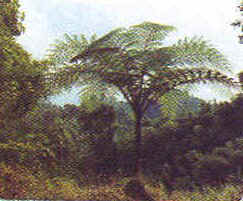 A
tree fern is some times used as a support for black pepper in the Nicobar Group
of Islands and the pounded leaves are used on wounds and sores by the Nicobarese.
It is endemic to Nicobars, restricted to Central and South Nicobars. It is a
threatened species.
A
tree fern is some times used as a support for black pepper in the Nicobar Group
of Islands and the pounded leaves are used on wounds and sores by the Nicobarese.
It is endemic to Nicobars, restricted to Central and South Nicobars. It is a
threatened species.
Cycas rumphii Miq.
A
rare cycad. The leaves and fruits are cooked and eaten. In India, it
is found in Andaman and Nicobar Islands. An elegant evergreen palm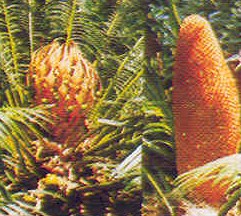 like tree. Nicobarese decorate the welcome gates by the entire leaves of the
plant. The fruit when ripe turns to orange colour and is chopped into
pieces by the Nicobarese and dried in sun for about a month, then grind into
flour which is cooked with chopped coconut kernel and eaten as staple
food. The fruit or seeds are applied to ulcers wound and skin
diseases. It is a source of Ayurvedic drug, Vidari is used in heart
disease as tonic.
like tree. Nicobarese decorate the welcome gates by the entire leaves of the
plant. The fruit when ripe turns to orange colour and is chopped into
pieces by the Nicobarese and dried in sun for about a month, then grind into
flour which is cooked with chopped coconut kernel and eaten as staple
food. The fruit or seeds are applied to ulcers wound and skin
diseases. It is a source of Ayurvedic drug, Vidari is used in heart
disease as tonic.
Baccaurea ramiflora Lour.
(Hindi: Khata phal, English: Rambai)
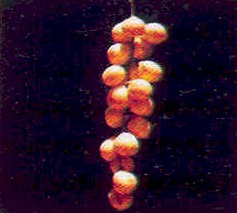 It
is one of the medicinal plant very common in Andamans & popularly known as
Kataphal amongst the Local inhabitants. Flowers are small and cream coloured.
Fruits are orange yellow when ripe and used as cooling drink. Leaves help in
digestion.
It
is one of the medicinal plant very common in Andamans & popularly known as
Kataphal amongst the Local inhabitants. Flowers are small and cream coloured.
Fruits are orange yellow when ripe and used as cooling drink. Leaves help in
digestion.
Couroupita guianensis Aubl.
(Bengali : Nagalingam, Hindi : Shivalingam, English : Cannon- ball tree)
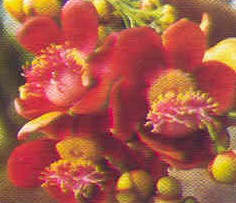 It
is believed that this species is introduced in these islands at the time of
settlement or even before 7947 and are worshipped especially by the couples for
attaining parenthood. The flowers are borne in much profusion and the fruits
attain their maximum size like a ba". The curious arrangements of the
stamens is apparently to ensure self-pollination.
It
is believed that this species is introduced in these islands at the time of
settlement or even before 7947 and are worshipped especially by the couples for
attaining parenthood. The flowers are borne in much profusion and the fruits
attain their maximum size like a ba". The curious arrangements of the
stamens is apparently to ensure self-pollination.
Pandanus odoratissimus Linn.f.
(Kewda)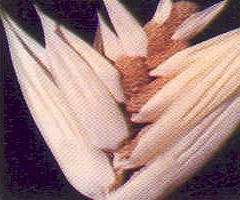
The male flowers are valued for their fragrance and used for the hair decoration & the extraction of kewda attar and kewda water are highly prized in Indian perfumery. It is very frequent in all the groups of Islands.
Heritiera littoralis Dryander ex.W.Ait.
 Commonly
known as 'Sundari'. The Sunderban is named after this plant. Nicobarese call it
Kamaaeuot, Onges call it Moro. A littoral tree conspicuous with its huge
buttress. The leaves are dark green above, silvery white beneath. The timber is
chiefly employed in building boats, canoes, ships & wharfs, used for
furniture and tool handles. The bark contains tannin. The Onge tribals of these
Islands prepare a kind of tea from the leaves and seeds. The leaves are used by
the Nicobarese for headache and body pain. It is very common mangroves along the
sea shores of all the group of Islands.
Commonly
known as 'Sundari'. The Sunderban is named after this plant. Nicobarese call it
Kamaaeuot, Onges call it Moro. A littoral tree conspicuous with its huge
buttress. The leaves are dark green above, silvery white beneath. The timber is
chiefly employed in building boats, canoes, ships & wharfs, used for
furniture and tool handles. The bark contains tannin. The Onge tribals of these
Islands prepare a kind of tea from the leaves and seeds. The leaves are used by
the Nicobarese for headache and body pain. It is very common mangroves along the
sea shores of all the group of Islands.
Vanilla andamanica Rolfe
(Orchid)
This
climbing orchid is endemic to Andaman & Nicobar Isla nds,
it has creamy white fragrant flowers. It is considered to be wild relative of
Vanilla planifolia which is the source of 'Vanilla' essence, which is used for
flavouring Ice creams, cakes etc.
nds,
it has creamy white fragrant flowers. It is considered to be wild relative of
Vanilla planifolia which is the source of 'Vanilla' essence, which is used for
flavouring Ice creams, cakes etc.
Dillenia indica Linn.
(Elephant apple)
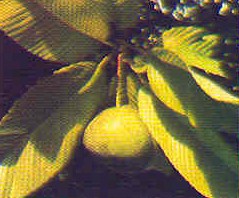 It
is an evergreen tree found in the Indian land mass. The fruit is covered by
fleshy calyx and the seed is covered by fleshy proteinacious aril which is used
in curry, pickle and jelly preparations. The fruits are said to be relished by
elephant and hence the name.
It
is an evergreen tree found in the Indian land mass. The fruit is covered by
fleshy calyx and the seed is covered by fleshy proteinacious aril which is used
in curry, pickle and jelly preparations. The fruits are said to be relished by
elephant and hence the name.
Calophyllum inophyllum Linn.
(Alexandrian laurel - A common seashore tree)
Popularly
known as 'Poon' in Hindi. It is a shaddy littoral tree. Leaves shiny dark green Flowers marble white. Uses: Canoe making, Barks applied to swollen glands.
Leaves used in Bone fracture. Resin used as tonic for Ulcers. Seed oil used in
rheumatism Distribution: Galathea to Pygmalion point in Great Nicobar, Dugong
Creek in Little Andaman, Neil Island, South Andaman & Middle Andaman.
Flowers marble white. Uses: Canoe making, Barks applied to swollen glands.
Leaves used in Bone fracture. Resin used as tonic for Ulcers. Seed oil used in
rheumatism Distribution: Galathea to Pygmalion point in Great Nicobar, Dugong
Creek in Little Andaman, Neil Island, South Andaman & Middle Andaman.
Dipterocarpus alatus Roxb.
(Garjan)
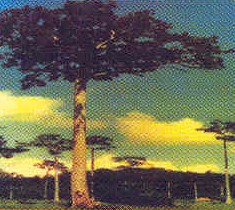 This
species has been reported to occur in Andamans. A lofty evergreen tree. The wood
is extensively used for internal construction work, making packing cases and
wagon construction. An volatile oil is obtained from this tree, commonly known
as garjan oil which is applied on ulcerated wounds. The bark is also a part of a
compound mixture to treat toothache. Many other species of Dipterocarpus are
found in these islands, which yield very useful timber and fuel wood.
This
species has been reported to occur in Andamans. A lofty evergreen tree. The wood
is extensively used for internal construction work, making packing cases and
wagon construction. An volatile oil is obtained from this tree, commonly known
as garjan oil which is applied on ulcerated wounds. The bark is also a part of a
compound mixture to treat toothache. Many other species of Dipterocarpus are
found in these islands, which yield very useful timber and fuel wood.
Xylocarpus molluccensis (Lam.) Roem.
(Puzzle fruit)
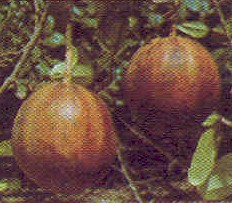 The
fruit is a cure for elephantiasis. The seed kernels are bitter and it is used as
tonic in relieving colic. The wood of the tree is used for making boats, house
posts, furniture and wheel spokes. It is also suitable for second grade pencils.
The plant parts contain high tannin.
The
fruit is a cure for elephantiasis. The seed kernels are bitter and it is used as
tonic in relieving colic. The wood of the tree is used for making boats, house
posts, furniture and wheel spokes. It is also suitable for second grade pencils.
The plant parts contain high tannin.
(Onge-Toyongo, Nicobarese - Tapileialo)
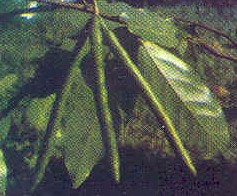 The
leaves of the shrub are chewed and the juice is smeared all over the body and
taken internally in the process of honey collection by the Onges of Little
Andaman Island. This is claimed as a repellent against honeybee stinging. It is
endemic to the Bay islands and found in Little Andaman Island and all the groups
of Nicobar.
The
leaves of the shrub are chewed and the juice is smeared all over the body and
taken internally in the process of honey collection by the Onges of Little
Andaman Island. This is claimed as a repellent against honeybee stinging. It is
endemic to the Bay islands and found in Little Andaman Island and all the groups
of Nicobar.
Abroma angusta Linn.
(Devils cotton)
A
large spreading shrub with fibrous bark and irritant hairs. The fibre from the
bark makes a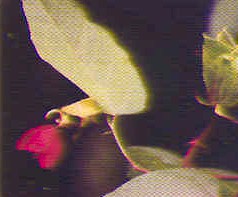 pliable
and attractive rope which is used in fishing nets. The fresh viscid sap of the
root bark is considered to be a valuable emenagogue and uterine tonic. The root
has also been applied to treat itch. It occurs in South Andaman and Central
Nicobars.
pliable
and attractive rope which is used in fishing nets. The fresh viscid sap of the
root bark is considered to be a valuable emenagogue and uterine tonic. The root
has also been applied to treat itch. It occurs in South Andaman and Central
Nicobars.
Knema andamanica (warb.) de Wilde
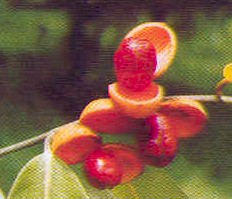 The
tree is a source of ayurvedic drug Jatiphalam which is used in indigestion and
diarrhoea, it is very common in the Forest of all the group of Islands. It is
reported to be endemic to Bay islands.
The
tree is a source of ayurvedic drug Jatiphalam which is used in indigestion and
diarrhoea, it is very common in the Forest of all the group of Islands. It is
reported to be endemic to Bay islands.
Designed & Published by
SCIENCE CENTRE
Goodwill Estate
Corbyn's Cove Road, Port Blair.
In co-ordination with the
DEPARTMENT OF ENVIRONMENT & FORESTS.
Andaman & Nicobar Islands